Common bean
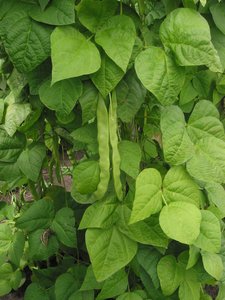
Description:
This entry describes all varieties of the common bean. This includes vining and bush/darf variaties and can have different names depending on their style of growths (see alternate names). These include the kidney bean, the navy bean, the pinto bean, the French bean and the wax bean
The common bean, scientific name Phaseolus vulgaris, is a herbaceous annual plant native to the Americas, specifically the regions extending from the southwestern United States to South America. It is a member of the Fabaceae (legume) family.
The common bean has a range of different appearances, depending on the variety. Most varieties have a simple, erect stem that grows to a height of 20-60 cm. The leaves are typically green and consist of 3-5 oblong leaflets. The flowers are small and white, pink, or purple in color. The fruit is a legume, which contains the seeds.
The common bean is typically a small plant, but some varieties can grow to be quite large, reaching heights of up to 2 meters. The plant grows relatively quickly, with the growing season typically lasting between 60-100 days.
The common bean prefers well-drained soil and full sun, but can also grow in partial shade. It is sensitive to frost and should be planted after the last frost date in the spring. To cultivate the common bean successfully, a grower may need to ensure that the soil is adequately fertilized and provide support for the plant to climb, if necessary.
The common bean is edible, with the seeds and the young pods being the most commonly consumed parts. The seeds can be cooked and eaten as a protein-rich vegetable, and the young pods can be eaten as a green vegetable. The edible parts can be stored after harvest by drying the seeds or by preserving the young pods in vinegar or oil.
The common bean has many uses beyond being a food source. The plant can fix nitrogen in the soil, improving its fertility and making it a useful companion plant for other crops. The dried leaves and stems of the common bean can be used as mulch or as a source of organic matter. In some cultures, the fibers from the stems are used to make ropes or other weaving materials. Additionally, the plant has been used medicinally to treat a variety of ailments.
The common bean is also valuable for wildlife. The flowers attract bees and other pollinators, and the plant provides food for a variety of insects, birds, and small mammals.
### Links
[Beans Seed Starting Tips @ Harvest to Table](https://harvesttotable.com/beans-seed-starting-tips/)
### Propagation - direct sow
Direct-sow beans in spring after all danger of frost has passed and soil is at least 16°C (60°F). In warm-winter regions, sow beans in late summer for harvest in winter. Time sowing so that beans come to harvest before the first frost.
Layer: Vines
USDA Hardiness Zone: 2 - 11
Edible: Yes
Edible parts: Leaves, Seed, Seedpod
Edible uses: Coffee, Condiment
Light requirement: Full sun
Water requirement: Moist
Soil pH (from catalog): 6.0 – 6.8
Soil texture preferences: Light sandy, Medium, Heavy clay
Spacing: 16cm
Width: 0.4
Utilities: Nitrogen fixer, Biomass, Dye, Antifungal
Native To: Costa Rica, Guatemala, Honduras, Mexico Central, Mexico Gulf, Mexico Northeast, Mexico Northwest, Mexico Southeast, Mexico Southwest, Nicaragua, Panamá
Introduced To: Costa Rica, Guatemala, Honduras, Mexico Central, Mexico Gulf, Mexico Northeast, Mexico Northwest, Mexico Southeast, Mexico Southwest, Nicaragua, Panamá
More from Permapeople
- Alternate name
- Pole bean, Climbing bean, French bean, Bush bean, Dwarf bean, Kidney bean, Green bean
- Days to harvest
- 45-85
- Dutch name
- Sperzieboon
- Family
- Fabaceae, Leguminosae
- German name
- Stangenbohne
- Germination temperature
- 16-18°c (70-80°f)
- Germination time
- 4-10 days
- Growth
- Fast
- Height
- 2.0
- Introduced into
- Altay, Amur, Andaman Is., Angola, Argentina Northeast, Argentina Northwest, Assam, Baltic States, Bangladesh, Belarus, Bolivia, Bulgaria, Buryatiya, Cameroon, Cayman Is., Central European Rus, Chad, Chita, Colombia, Comoros, Cuba, Czechoslovakia, Dominican Republic, East European Russia, East Himalaya, Ecuador, Ethiopia, Guinea, Gulf of Guinea Is., Haiti, Illinois, India, Iraq, Irkutsk, Jamaica, Jawa, Kazakhstan, Kenya, Khabarovsk, Kirgizstan, Korea, Krasnoyarsk, Kuril Is., Leeward Is., Malaya, Marianas, Maryland, Mongolia, Myanmar, Nepal, New Guinea, New York, Nicobar Is., Nigeria, North Caucasus, North European Russi, Northwest European R, Pakistan, Peru, Philippines, Primorye, Puerto Rico, Queensland, Rwanda, Sakhalin, Senegal, South European Russi, Sri Lanka, Tadzhikistan, Tanzania, Thailand, Togo, Transcaucasus, Trinidad-Tobago, Turkmenistan, Tuva, Uganda, Ukraine, Uzbekistan, Venezuela, Vietnam, Wake I., West Himalaya, West Siberia, Yakutskiya, Zambia, Zaïre
- Life cycle
- Annual
- Plants for a future
- https://pfaf.org/User/Plant.aspx?LatinName=Phaseolus vulgaris
- Plants of the world online
- https://powo.science.kew.org/taxon/urn:lsid:ipni.org:names:514191-1
- Propagation method
- Seed - transplant, Seed - direct sow
- Seed planting depth
- 2.5 cm
- Seed viability
- 3-5 years
- When to sow (indoors)
- 2-4 weeks before last frost
- When to sow (outdoors)
- 1 week after last frost, 12-14 weeks before first frost
- Wikipedia
- https://en.wikipedia.org/wiki/Phaseolus_vulgaris
Slug: phaseolus-vulgaris-common-bean
Permapeople ID: 5