Black locust
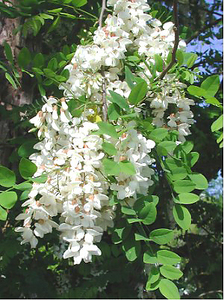
Description:
Black locust (Robinia pseudoacacia) is a fast-growing tree that is native to the eastern United States. It is a member of the pea family, Fabaceae, and is known for its fragrant, white flowers and dark, hardwood timber.
Black locust trees can grow to a height of 80-100 feet and have a straight, upright growth habit. The bark is dark and furrowed, and the leaves are compound, with 7-19 oval-shaped leaflets arranged along a central stem. The flowers are fragrant and bloom in clusters in the spring, and are followed by long, slender seed pods that contain small, brown seeds.
To grow black locust successfully, it is important to choose a location with well-drained, fertile soil and full sun. The tree is adaptable and can grow in a variety of soil types, but prefers moist conditions and does not tolerate drought well. Black locust can also be grown in containers, but will need to be repotted regularly to accommodate its rapid growth.
Black locust wood is strong and durable, and is often used for fence posts, poles, and other construction purposes. The bark, leaves, and flowers can also be used for a variety of purposes. The bark can be used to make a yellow dye, and the leaves and flowers can be used as a natural insect repellent. The flowers are also edible, and can be used to make a sweet, fragrant tea.
Black locust is also a valuable food source for wildlife, including birds, deer, and small mammals. The flowers attract bees and other pollinators, and the seeds are eaten by birds and other animals.
It is important to note that, while black locust is generally safe to handle and consume, the plant contains toxic compounds that can cause irritation and allergic reactions in some people. Additionally, black locust is considered invasive in some areas, and can spread rapidly if not controlled.
Layer: Trees
USDA Hardiness Zone: 4 - 9
Edible: Yes
Edible parts: Flowers, Seed, Seedpod
Edible uses: Oil, Condiment, Drink
Light requirement: Full sun
Water requirement: Dry, Moist
Soil texture preferences: Light sandy, Medium, Heavy clay
Width: 3.0
Utilities: Nitrogen fixer, Oil, Fiber, Lumber, Dye, Essential oil, Dynamic accumulator, Fragrance, Fire starter, Animal feed, Erosion control
Native To: Alabama, Georgia, Illinois, Kentucky, Maryland, Pennsylvania, Tennessee, Vermont
Introduced To: Alabama, Georgia, Illinois, Kentucky, Maryland, Pennsylvania, Tennessee, Vermont
Warnings: Weed potential
More from Permapeople
- 1000 seed weight (g)
- 19.2
- Alternate name
- Yellow locust
- Family
- Fabaceae or leguminosae
- German name
- Gewöhnliche robinie
- Growth
- Fast
- Height
- 25.0
- Introduced into
- Albania, Algeria, Argentina Northeast, Austria, Azores, Baltic States, Belarus, Belgium, Bulgaria, California, Canary Is., Cape Provinces, Central European Rus, Chile Central, China North-Central, China South-Central, China Southeast, Colorado, Czechoslovakia, East Aegean Is., East European Russia, Easter Is., France, Free State, Germany, Great Britain, Greece, Hungary, Idaho, India, Inner Mongolia, Iraq, Italy, Japan, Kazakhstan, Khabarovsk, Kirgizstan, Korea, Kriti, Krym, Kuril Is., KwaZulu-Natal, Lebanon-Syria, Lesotho, Libya, Madeira, Manchuria, Mexico Northwest, Minnesota, Morocco, Netherlands, Nevada, New Mexico, New York, New Zealand North, New Zealand South, North Caucasus, Northern Provinces, Oregon, Pakistan, Palestine, Poland, Primorye, Qinghai, Romania, Réunion, Sakhalin, Sardegna, Sicilia, South European Russi, Spain, Switzerland, Tadzhikistan, Taiwan, Texas, Transcaucasus, Turkey, Turkey-in-Europe, Turkmenistan, Ukraine, Uzbekistan, Washington, West Himalaya, Wisconsin, Xinjiang, Yugoslavia
- Life cycle
- Perennial
- Plants for a future
- https://pfaf.org/User/Plant.aspx?LatinName=Robinia pseudoacacia
- Plants of the world online
- https://powo.science.kew.org/taxon/urn:lsid:ipni.org:names:30034699-2
- Wikipedia
- https://en.wikipedia.org/wiki/Robinia_pseudoacacia
Slug: robinia-pseudoacacia-black-locust
Permapeople ID: 11