Yarrow
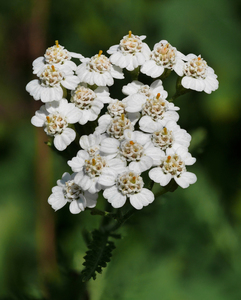
Description:
Yarrow (Achillea millefolium) is a perennial plant that is native to temperate regions of the Northern Hemisphere, including Europe, Asia, and North America. It is commonly found in meadows, grasslands, and along roadsides.
Yarrow has fern-like leaves that are divided into many narrow, tooth-like segments. The leaves are typically dark green in color and grow in a basal rosette. The plant produces small, white or pink flowers that are arranged in compact, flat-topped clusters. The flowers are attractive to pollinators such as bees and butterflies.
Yarrow typically grows to a height of 30-90 cm (12-36 in) and has a spreading habit. It is a fast-growing plant that can quickly colonize an area through its rhizomatous root system. Yarrow is often differentiated from similar plants by its strongly scented leaves and its distinctive flower clusters.
Yarrow prefers well-drained soils and full sun to partial shade. It is drought-tolerant and can grow in a variety of soil types, including sandy, loamy, and clay soils. To cultivate yarrow successfully, it is important to space the plants adequately to allow for good air circulation and to prevent the spread of diseases. Yarrow can also be propagated through dividing the root crowns or by planting seeds.
Some parts of yarrow, such as the leaves and flowers, are edible and can be used in salads or as a garnish. The leaves have a slightly bitter, astringent flavor and can be used fresh or dried. The flowers can also be used to make tea. It is important to note that some people may experience allergic reactions to yarrow, so it is best to try a small amount first before consuming it in larger quantities.
Yarrow has a long history of use in traditional medicine, where it has been used to treat a wide range of ailments, including wounds, infections, and fevers. It is also believed to have anti-inflammatory and astringent properties. In the garden, yarrow can be used as a natural insect repellent, as a mulch to suppress weeds, and as a companion plant to improve the health and vigor of other plants.
Yarrow is valuable to wildlife as a nectar and pollen source for pollinators. It also provides shelter and habitat for beneficial insects, such as ladybugs and lacewings, which help to control pest populations in the garden. Overall, yarrow is a versatile and useful plant that can add beauty and functionality to a garden or farm.
Layer: Herbs
USDA Hardiness Zone: 4 - 8
Edible: Yes
Edible parts: Leaves
Edible uses: Condiment, Tea
Light requirement: Full sun, Partial sun/shade
Water requirement: Dry, Moist
Soil texture preferences: Light sandy, Medium, Heavy clay
Utilities: Ground cover, Dye, Compost, Essential oil, Dynamic accumulator, Fragrance, Animal feed, Cosmetic, Companion, Hair
Native To: Afghanistan, Alabama, Alaska, Albania, Alberta, Altay, Amur, Arizona, Arkansas, Austria, Baltic States, Belarus, Belgium, British Columbia, Bulgaria, Buryatiya, California, Central European Rus, Chita, Colorado, Connecticut, Czechoslovakia, Delaware, Denmark, District Of Columbia, East European Russia, East Himalaya, Finland, Florida, France, Føroyar, Georgia, Germany, Great Britain, Greece, Greenland, Guatemala, Hungary, Iceland, Idaho, Illinois, Indiana, Iowa, Iran, Iraq, Ireland, Irkutsk, Italy, Kamchatka, Kansas, Kazakhstan, Kentucky, Khabarovsk, Kirgizstan, Krasnoyarsk, Krym, Kuril Is., Labrador, Lebanon-syria, Louisiana, Magadan, Maine, Manitoba, Maryland, Massachusetts, Mexico Central, Mexico Gulf, Mexico Northeast, Mexico Northwest, Mexico Southeast, Mexico Southwest, Michigan, Minnesota, Mississippi, Missouri, Mongolia, Montana, Nebraska, Netherlands, Nevada, New Brunswick, New Hampshire, New Jersey, New Mexico, New York, Newfoundland, North Carolina, North Caucasus, North Dakota, North European Russi, Northwest European R, Northwest Territorie, Norway, Nova Scotia, Nunavut, Ohio, Oklahoma, Ontario, Oregon, Pakistan, Pennsylvania, Poland, Portugal, Primorye, Prince Edward I., Québec, Rhode I., Romania, Sakhalin, Sardegna, Saskatchewan, Sicilia, South Carolina, South Dakota, South European Russi, Spain, Sweden, Switzerland, Tadzhikistan, Tennessee, Texas, Transcaucasus, Turkey, Turkey-in-europe, Turkmenistan, Tuva, Ukraine, Utah, Uzbekistan, Vermont, Virginia, Washington, West Himalaya, West Siberia, West Virginia, Wisconsin, Wyoming, Yakutskiya, Yugoslavia, Yukon
Introduced To: Afghanistan, Alabama, Alaska, Albania, Alberta, Altay, Amur, Arizona, Arkansas, Austria, Baltic States, Belarus, Belgium, British Columbia, Bulgaria, Buryatiya, California, Central European Rus, Chita, Colorado, Connecticut, Czechoslovakia, Delaware, Denmark, District Of Columbia, East European Russia, East Himalaya, Finland, Florida, France, Føroyar, Georgia, Germany, Great Britain, Greece, Greenland, Guatemala, Hungary, Iceland, Idaho, Illinois, Indiana, Iowa, Iran, Iraq, Ireland, Irkutsk, Italy, Kamchatka, Kansas, Kazakhstan, Kentucky, Khabarovsk, Kirgizstan, Krasnoyarsk, Krym, Kuril Is., Labrador, Lebanon-syria, Louisiana, Magadan, Maine, Manitoba, Maryland, Massachusetts, Mexico Central, Mexico Gulf, Mexico Northeast, Mexico Northwest, Mexico Southeast, Mexico Southwest, Michigan, Minnesota, Mississippi, Missouri, Mongolia, Montana, Nebraska, Netherlands, Nevada, New Brunswick, New Hampshire, New Jersey, New Mexico, New York, Newfoundland, North Carolina, North Caucasus, North Dakota, North European Russi, Northwest European R, Northwest Territorie, Norway, Nova Scotia, Nunavut, Ohio, Oklahoma, Ontario, Oregon, Pakistan, Pennsylvania, Poland, Portugal, Primorye, Prince Edward I., Québec, Rhode I., Romania, Sakhalin, Sardegna, Saskatchewan, Sicilia, South Carolina, South Dakota, South European Russi, Spain, Sweden, Switzerland, Tadzhikistan, Tennessee, Texas, Transcaucasus, Turkey, Turkey-in-europe, Turkmenistan, Tuva, Ukraine, Utah, Uzbekistan, Vermont, Virginia, Washington, West Himalaya, West Siberia, West Virginia, Wisconsin, Wyoming, Yakutskiya, Yugoslavia, Yukon
Warnings: Weed potential
More from Permapeople
- 1000 seed weight (g)
- 0.2
- Alternate name
- Boreal yarrow, california yarrow, giant yarrow, coast yarrow, western yarrow, pacific yarrow, bloodwort, carpenter's weed, common yarrow, hierba de las cortaduras, milfoil, plumajillo
- Family
- Asteraceae or compositae
- German name
- Gemeine schafgarbe
- Growth
- Fast
- Height
- 0.6
- Introduced into
- Antipodean Is., Argentina Northeast, Argentina Northwest, Argentina South, Azores, Baleares, Bolivia, Borneo, Botswana, Brazil North, Brazil Northeast, Brazil South, Brazil Southeast, Brazil West-Central, Cameroon, Cape Provinces, Chatham Is., Chile Central, Chile North, Chile South, Colombia, Corse, Costa Rica, Cuba, Cyprus, Dominican Republic, Ecuador, Falkland Is., Free State, Haiti, Hawaii, Honduras, India, Inner Mongolia, Jamaica, Japan, Jawa, Korea, KwaZulu-Natal, Lesotho, Madeira, Malaya, Namibia, New South Wales, New Zealand North, New Zealand South, Nicaragua, Northern Provinces, Northern Territory, Paraguay, Peru, Philippines, Queensland, South Australia, South Georgia, Sulawesi, Sumatera, Taiwan, Tasmania, Uruguay, Victoria, Vietnam, Western Australia, Xinjiang, Zimbabwe
- Life cycle
- Perennial
- Plants for a future
- https://pfaf.org/User/Plant.aspx?LatinName=Achillea millefolium
- Plants of the world online
- https://powo.science.kew.org/taxon/urn:lsid:ipni.org:names:2294-2
- Wikipedia
- https://en.wikipedia.org/wiki/Achillea_millefolium
Slug: achillea-millefolium-yarrow
Permapeople ID: 172