Toothache plant
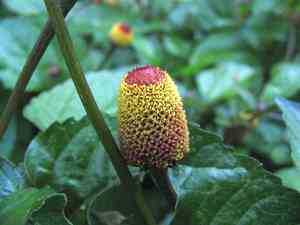
Layer: Not specified
USDA Hardiness Zone: 9 - 11
Edible: Yes
Edible parts: Leaves
Edible uses: Oil
Light requirement: Full sun
Water requirement: Moist
Soil texture preferences: Light sandy, Medium, Heavy clay
Utilities: Oil, Pest control, Cosmetic, Containers, Cut flowers
Native To: Brazil Southeast
Introduced To: Brazil Southeast
More from Permapeople
- Alternate name
- Paracress, paracress, sichuan buttons, buzz buttons, tingflowers, electric daisy an-ka-sa-kir, an-sa-te, berro, berro de para, borousni, brede mafane, cresson de para, ibouoni, jambu, marsang, marshang, motum mersh, oubouonou, phak khrat, rasun sak, tipebouoti, toothacheplant, yoritampobou [1-4]
- Family
- Asteraceae or compositae
- Growth
- Fast
- Height
- 0.4
- Introduced into
- Assam, Bangladesh, Benin, Bolivia, Brazil North, Brazil Northeast, Brazil South, Central African Repu, Colombia, Comoros, Cuba, Ecuador, Gabon, India, Jawa, Leeward Is., Mali, Mauritius, Myanmar, Nepal, Peru, Réunion, Sri Lanka, Taiwan, Vietnam, Windward Is., Zaïre
- Life cycle
- Perennial
- Plants for a future
- https://pfaf.org/User/Plant.aspx?LatinName=Acmella oleracea
- Plants of the world online
- https://powo.science.kew.org/taxon/urn:lsid:ipni.org:names:914778-1
- Wikipedia
- https://en.wikipedia.org/wiki/Acmella_oleracea
Slug: acmella-oleracea-toothache-plant
Permapeople ID: 2140