Urtica dioica
Description:
Stinging nettle (Urtica dioica) is a perennial plant that is native to many parts of Europe, Asia, and North America. It is found in a variety of habitats, including damp forests, stream banks, and meadows.
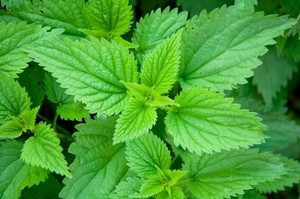
Stinging nettle has green, heart-shaped leaves that are arranged opposite each other on the stem. The leaves and stems are covered with tiny, hollow hairs that can inject a painful, stinging sensation when they come into contact with skin. The plant also produces small, greenish-white flowers that grow in clusters.
Stinging nettle can grow to be quite tall, sometimes reaching heights of up to six feet. It grows quickly and can spread rapidly.
To cultivate stinging nettle, it is best to start with rooted cuttings or small plants. The plant prefers moist, well-draining soil and partial shade, but it can also grow in full sun. It is important to keep the soil consistently moist, especially during the plant's first growing season.
Stinging nettle is edible, but the leaves and stems must be cooked or dried to remove the stinging hairs. The leaves can be used in a variety of dishes, including soups, stews, and teas. They can also be dried and stored for later use. The roots can also be eaten, but they are more difficult to harvest and prepare.
Stinging nettle has a number of uses, both medicinal and practical. The leaves and stems can be used to make a tea that is rich in vitamins and minerals, and has been used to treat a variety of conditions, including arthritis, eczema, and gout. The plant can also be used as a natural fertilizer, thanks to its high nitrogen content. In addition, the leaves can be used as mulch, and the fibers from the stems can be used to make ropes and cloth.
Stinging nettle is also valuable for wildlife, providing food and habitat for a variety of animals. The leaves are a source of food for many species of butterflies and moths, and the plant also provides shelter for small mammals and birds.
Overall, stinging nettle is a versatile and useful plant that has a variety of applications for gardeners, farmers, and herbalists. Despite its painful sting, it is a valuable addition to any garden or landscape.
Layer: Herbs
USDA Hardiness Zone: 3 - 10
Edible: Yes
Edible parts: Leaves, Shoots
Edible uses: Oil, Colouring, Curdling agent, Drink
Light requirement: Full sun, Partial sun/shade
Water requirement: Moist
Soil texture preferences: Light sandy, Medium, Heavy clay
Utilities: Oil, Fiber, Biomass, Dye, Compost, Dynamic accumulator, Animal feed, Hair, Waterproofing
Native To: Afghanistan, Albania, Algeria, Altay, Amur, Assam, Austria, Baltic States, Belarus, Belgium, Bulgaria, Buryatiya, Central European Rus, China North-central, China South-central, Chita, Corse, Czechoslovakia, Denmark, East Aegean Is., East European Russia, East Himalaya, Finland, France, Føroyar, Germany, Great Britain, Greece, Hungary, Iceland, India, Inner Mongolia, Iran, Iraq, Ireland, Irkutsk, Italy, Japan, Kamchatka, Kazakhstan, Khabarovsk, Kirgizstan, Korea, Krasnoyarsk, Kriti, Krym, Lebanon-syria, Magadan, Manchuria, Mongolia, Morocco, Nepal, Netherlands, North Caucasus, North European Russi, Northwest European R, Norway, Pakistan, Poland, Portugal, Primorye, Qinghai, Romania, Sakhalin, Sardegna, Sicilia, South European Russi, Spain, Sweden, Switzerland, Tadzhikistan, Tibet, Transcaucasus, Tunisia, Turkey, Turkey-in-europe, Turkmenistan, Tuva, Ukraine, Uzbekistan, West Himalaya, West Siberia, Xinjiang, Yakutskiya, Yugoslavia
Introduced To: Afghanistan, Albania, Algeria, Altay, Amur, Assam, Austria, Baltic States, Belarus, Belgium, Bulgaria, Buryatiya, Central European Rus, China North-central, China South-central, Chita, Corse, Czechoslovakia, Denmark, East Aegean Is., East European Russia, East Himalaya, Finland, France, Føroyar, Germany, Great Britain, Greece, Hungary, Iceland, India, Inner Mongolia, Iran, Iraq, Ireland, Irkutsk, Italy, Japan, Kamchatka, Kazakhstan, Khabarovsk, Kirgizstan, Korea, Krasnoyarsk, Kriti, Krym, Lebanon-syria, Magadan, Manchuria, Mongolia, Morocco, Nepal, Netherlands, North Caucasus, North European Russi, Northwest European R, Norway, Pakistan, Poland, Portugal, Primorye, Qinghai, Romania, Sakhalin, Sardegna, Sicilia, South European Russi, Spain, Sweden, Switzerland, Tadzhikistan, Tibet, Transcaucasus, Tunisia, Turkey, Turkey-in-europe, Turkmenistan, Tuva, Ukraine, Uzbekistan, West Himalaya, West Siberia, Xinjiang, Yakutskiya, Yugoslavia
Warnings: Weed potential
More from Permapeople
- Alternate name
- California nettle, achoka, bichhu booti, bichhua, bichua, chichru, irhawurhawu, kopriva, korvenoges, krapiva, noges, patle sishnu, pokrzywa, polo, raudnoges, sishnu, sisnu, tall nettle, zara, zastisod, zocha, american stinging nettle, brandnetelwortel, brennessel, brennesselblätter, brennesselwurzel, brennnesselwurzel, brännässelrot, brännässla, brännässleblad, brændenælderod, california nettle, chalkan, chayan oot, chhoku, chichicaste, chule, chutle, common nettle, common stinging nettle for homoeopathic preparations, csalángyökér, csalánlevé, dhyo, european nettle, european stinging nettle, folia urticae, gazanda, gazaneh, gazgazuk, giant nettle, grande ortie, great nettle, greater nettle, grosse brennessel, große brennessel, gherq il-hurrieq, haarnesselwurzel, hanfnesselwurzel, hhurrayq, horeig, hyo, jhaduk, kajyang, kichitki oot, kopriva, koprivový koren, korenina koprive, korzen pokrzywy, krapiva dvudomnaya, nelau, neslerot, nesselwurzel, nettle, nettle herb, nettle leaf, nettle root, nettle stinging, nhyakan, nokkonen, juuri, nõgesejuur, natru saknes, ortica, ortica maschio, ortica radice, ortie, ortie (feuille d’), ortie (racine d'), ortie brulante, ortie dioïque, ortiga, ortiga mayor, hoja, raíz de, pokrzywa, polo, pulu, prhlavový koren, qurrays, racine d'ortie, radix urticae, raiz de ortiga, radacina de urzica, satu, sikya, sisna, sisnu, slender nettle, stinging nettle, stinging nettle herb, syak, tall nettle, tsuknida, urtica dioica, urtica dioica ad praeparationes homoeopathicas, urticae folium, urticae herba, urticae radix, urtiga, raiz, urtiga-maior, urtiga-mansa, urtiga-vermelha, urtigão, yi zhu qian ma, za-chhag, zwa, zwyczajna, isirgan
- Family
- Urticaceae
- German name
- Brennnessel
- Growth
- Fast
- Height
- 1.2
- Introduced into
- Alabama, Alaska, Argentina Northeast, Bolivia, Brazil Northeast, Brazil South, Brazil Southeast, British Columbia, California, Cape Provinces, Chile Central, Chile South, Colombia, Connecticut, Delaware, District of Columbia, Ecuador, Eritrea, Falkland Is., Florida, Georgia, Greenland, Guatemala, Libya, Maine, Maryland, Massachusetts, Michigan, Missouri, New Brunswick, New Hampshire, New Jersey, New York, New Zealand North, New Zealand South, Newfoundland, North Carolina, Nova Scotia, Ohio, Oklahoma, Ontario, Oregon, Pennsylvania, Prince Edward I., Québec, Svalbard, Tennessee, Tristan da Cunha, Virginia, Washington, West Virginia
- Life cycle
- Perennial
- Plants for a future
- https://pfaf.org/User/Plant.aspx?LatinName=Urtica dioica
- Plants of the world online
- https://powo.science.kew.org/taxon/urn:lsid:ipni.org:names:260630-2
- Wikipedia
- https://en.wikipedia.org/wiki/Urtica_dioica
Slug: urtica-dioica
Permapeople ID: 217